12 August 2026
When the Sun Disappears
Eclipse, myth, and spiritual practice between tradition and contemporaneity
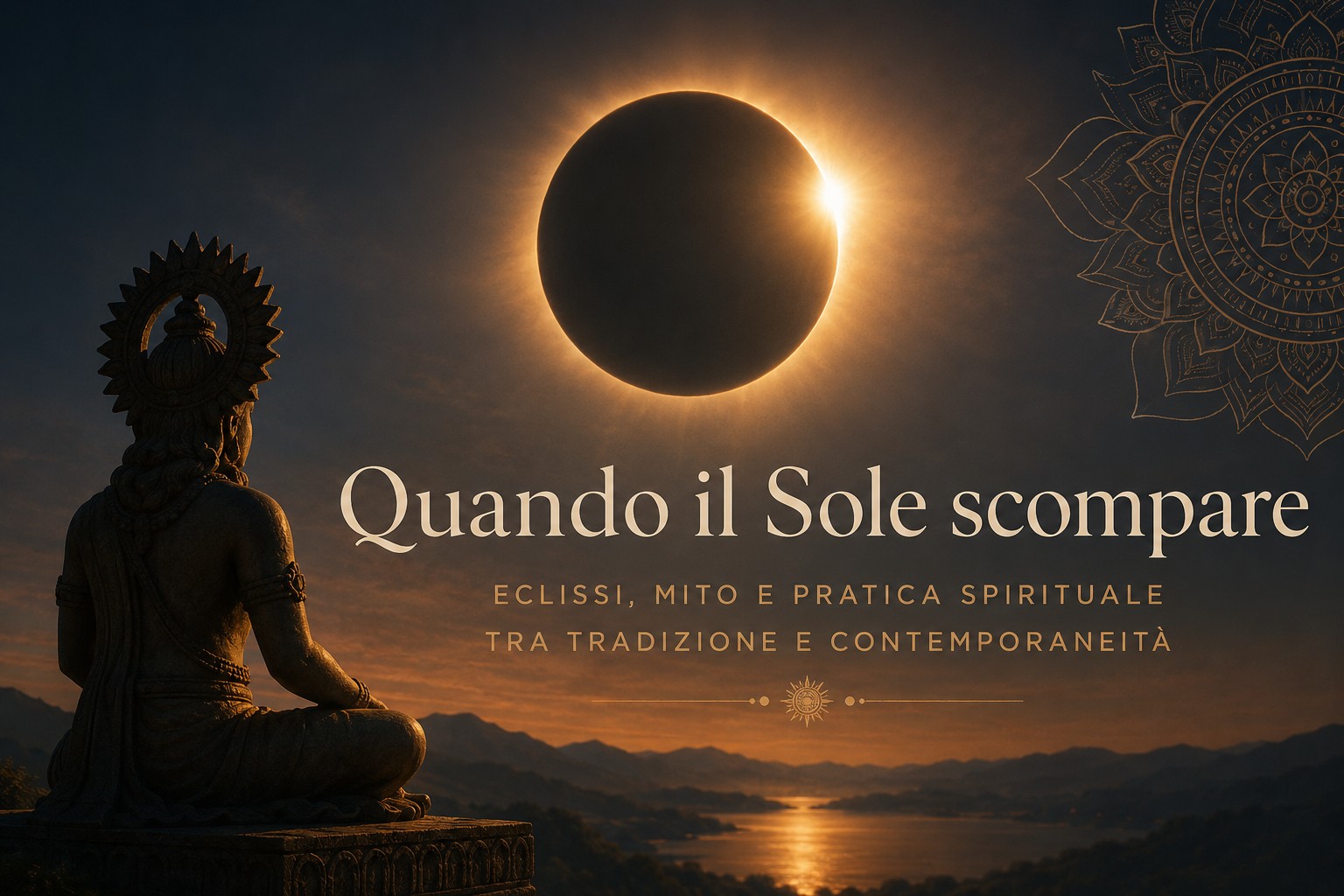
A solar eclipse, from an astronomical perspective, holds no mystery. The Moon passes between the Earth and the Sun, temporarily obscuring its light. Yet, knowing perfectly well how an eclipse occurs does not necessarily exhaust what happens when we experience it.
For most of human history, in fact, the sky has never been just sky.
The Sun marks the day, work, seasons, harvests. It is a source of light and warmth, and for cultures far apart, it has been a symbol of life, order, orientation, divinity, consciousness.
Then, suddenly, at the moment it should be there, its light diminishes.
The landscape changes.
The temperature can drop.
Shadows become unusual.
Animals may alter their behavior.
For a few minutes, something in the usual order of the world seems to be suspended. It is therefore not surprising that eclipses have generated myths, fears, astronomical observations, rituals, prayers, and spiritual practices.
Astronomy tells us what happens in the sky. Human cultures tell us what we have made of that experience. These are two different questions. And they can coexist.
Sūrya Grahaṇa: the "seizing" of the Sun
In Sanskrit, a solar eclipse is called Sūrya Grahaṇa.
Sūrya is the Sun. Grahaṇa denotes the act of taking, grasping, capturing, obscuring.
The term thus already contains a very powerful image: during the eclipse, the Sun is, temporarily, "seized". And it is precisely around this image that one of the most well-known stories of the Hindu tradition unfolds.
Rāhu and the Swallowed Sun
The story takes us to the Samudra Manthana, the famous "churning of the ocean of milk". Devas and Asuras, deities and antagonistic powers, collaborate to obtain amṛta, the nectar of immortality, from the ocean.
When the nectar finally emerges, an asura manages to blend in among the gods and drink a part of it. Sūrya and Chandra, the Sun and the Moon, notice the deception and report it to Viṣṇu. Viṣṇu intervenes and severs his head. But it is too late.
The asura has already tasted the amṛta and can no longer die completely.
His immortal head becomes Rāhu; in later tradition, the other part is associated with Ketu. Rāhu, remembering that it was the Sun and the Moon who denounced him, continues to chase them across the sky. Periodically, he manages to catch and swallow them.
It is then that the eclipse occurs.
But Rāhu no longer possesses a body capable of retaining them. And so, inevitably, the light reappears. It is difficult not to recognize the power of the image: the light is swallowed, disappears, and then returns.
There is also a fascinating detail.
In jyotiṣa, the Indian astrological tradition, Rāhu and Ketu are identified with the two lunar nodes, the points where the Moon's orbit intersects the ecliptic. And it is precisely when the Sun and Moon are near these nodes that eclipses can occur.
Before Rāhu: Svarbhānu and Atri
However, the story of Rāhu is not the only Indian story related to the obscuring of the Sun.
In the Ṛgveda, one of the oldest texts of the Vedic tradition, we find an episode in which the asura Svarbhānu strikes Sūrya with darkness.
The Sun loses its light.
The ṛṣi Atri, one of the great sage-seers of the Vedic tradition, intervenes, and the light of the Sun is restored. The passage has been interpreted by various scholars as one of the oldest Indian literary descriptions of a solar eclipse.
It is interesting because it reminds us that what we today generally call "Hindu tradition" actually encompasses thousands of years of texts, stories, schools, and transformations. There is no single Indian way of narrating the eclipse.
A Time Different from Everyday Time
Perhaps the most interesting aspect of Sūrya Grahaṇa, however, does not concern what is narrated, but what is done.
In various Hindu traditions, the eclipse represents a particular ritual period. Ordinary life is, at least temporarily, modified. Some activities are suspended. Others are intensified.
Practices may include:
japa, the meditative repetition of a mantra;
meditation and contemplation;
recitation of sacred texts;
prayer;
fasting or dietary restrictions;
dāna, offerings and acts of generosity;
ritual bathing and purification practices at the end of the eclipse.
In some traditions, there is also the concept of sūtaka, a ritually sensitive period associated with the eclipse during which particular precautions are observed.
Naturally, there is no single rule valid for all of Hinduism.
Practices vary enormously according to region, family, sampradāya, temple, and the religious tradition followed. And it is important to remember this whenever we use seemingly simple expressions like "according to Hinduism". Hinduism is a universe, not an instruction manual.
Protection and Practice Can Coexist
This allows us to understand a characteristic of eclipse-related traditions that, viewed from the outside, might seem contradictory.
On one hand, we find precautions, fasting, restrictions, and purification practices. On the other, we find mantras, meditation, and prayer.
The two are not necessarily in opposition.
If the eclipse represents a temporary alteration of the ordinary order, that time can demand attention and simultaneously become an opportunity for practice. What is exceptional is treated differently from the everyday. And perhaps this is precisely the most interesting point. Not necessarily considering the eclipse "good" or "bad".
But recognizing that that time is not lived as any ordinary time.
Why the mantra specifically?
Among the practices most frequently associated with eclipses, we find japa. Repeating. Again. And again.
The same sound.
The same formula.
The same rhythm.
From a contemplative point of view, it is interesting to observe what happens: while the sky changes in an extraordinary way, the response of practice does not necessarily consist in doing something equally extraordinary.
It can simply consist in remaining.
Sitting.
Breathing.
Repeating.
Gathering the mind around a sound.
Hindu traditions use different mantras during eclipses: the Gāyatrī Mantra, Oṃ Namaḥ Śivāya, the Mahāmṛtyuñjaya Mantra, mantras dedicated to Viṣṇu, or formulas addressed directly to Sūrya.
One of these is: Oṃ Sūryāya Namaḥ
A simple translation can be:
"Om, homage to Sūrya." or "I bow to the Sun."
Sūrya, in Indian tradition, is not just the luminous disk we see in the sky. It is associated with light, vitality, vision, the ability to illuminate and make visible. During an eclipse, addressing a mantra to the Sun then acquires a very simple symbolic meaning:
remaining turned towards the light precisely as the light passes through the shadow.
Not because the mantra should "bring back" the Sun; the Sun will return anyway. Perhaps it is us who need to remember it to reassure ourselves.
When the Sun Returns
When the eclipse ends, in various Hindu traditions, the return of light is followed by purification practices. One of the most well-known is the ritual bath.
In some sacred places in India, eclipses are still an occasion for great pilgrimages, and bathing in a sacred river at the end of the phenomenon takes on particular religious significance. The structure is fascinating. There is an order. Then something interrupts it. An exceptional period is traversed. Finally, order is re-established, and a ritual gesture accompanies the return to daily life.
The eclipse is not just something that happens.
It is something that is traversed.
In Tibetan Buddhism: Intensifying What is Beneficial
Even in Tibetan Buddhism, eclipses hold a special place. In some lineages of teaching, they are considered periods during which the karmic effects of actions are enormously amplified.
In the teachings transmitted by Lama Zopa Rinpoche, for example, particular attention is given to the actual period of the eclipse, and spiritual practice during that time is encouraged.
Mantra.
Meditation.
Prayer.
Virtuous actions.
And especially bodhicitta.
Bodhicitta is not simply "thinking positive" or generally feeling love towards the world. In Mahāyāna Buddhism, it indicates the intention to achieve awakening in order to benefit all sentient beings. It is a radical shift of attention: from one's own well-being to the well-being of others.
Other Skies, Other Stories
India is, of course, not the only culture to have attributed particular meanings to eclipses.
In various Asian traditions, we find celestial creatures attacking or devouring the Sun, and rituals in which noises, drums, or other instruments accompany the phenomenon.
In the Greek and Roman world, eclipses could be interpreted as omens, while increasingly sophisticated naturalistic explanations developed in parallel.
In Mayan civilization, astronomical observation and religious dimension could coexist: the Dresden Codex contains famous tables related to eclipse cycles. And this is perhaps one of the most interesting aspects. Myth and astronomy do not necessarily have to be imagined as two armies arrayed against each other. Humans can observe with great precision how the sky works and at the same time ask themselves what that sky means to them.
And the Celts? Beware of Modern Attributions
When we approach contemporary spirituality, however, a little caution is needed.
It is common to encounter statements that ancient Celts considered eclipses "energy portals," or practiced specific rituals for opening and closing these portals.
Historical sources on Celtic religions are fragmented and do not reliably support such attributions. Above all, we have no solid basis for attributing the modern concept of "eclipse energy portal" to the ancient Celts. This does not make contemporary spirituality any less interesting. It simply means distinguishing.
The "Eclipse Portal": Ancient or Modern?
Today, the spiritual language related to eclipses is very rich.
People speak of:
eclipse portals
energetic openings
manifestation
release
activations
new frequencies
transformations
These languages are widespread especially in contemporary astrology, New Age circles, and new forms of Western spirituality. They can hold a very strong symbolic meaning for those who use them. But we do not need to make them more authoritative by artificially attributing them to ancient civilizations.
A contemporary practice does not lose value because it is contemporary.
We do not need to say that "the ancient Celts already did it," or the Vedas, or some vaguely identified shamanic tradition for an experience to have meaning.
Instead, we can do something more respectful:
recognize the sources from which we draw inspiration, distinguish them from each other, and then openly declare when we are constructing a practice for our present.
Tradition does not need to be invented to be honored.
Perhaps not a portal, but a threshold
However, there is another word that can help us understand the experience of the eclipse:
threshold.
Not necessarily an energetic or supernatural threshold. A threshold in the human and ritual sense of the term. Many rituals, in fact, possess a very simple structure:
before.
crossing.
after.
One temporarily leaves ordinary time. One enters a different space. One passes through something. Then one returns.
The eclipse naturally possesses this same structure. The light slowly changes, the shadow grows, a climax arrives, then the movement reverses, and the light returns.
We do not need to invent a portal in the sky.
The sky already offers us a threshold.
Perhaps we do not need to choose between two extremes. We do not necessarily have to consider the eclipse a supernatural event. But neither are we obliged to reduce it to the sole phrase: "It's simply the Moon passing in front of the Sun."
Of course it is. And it is already extraordinary as it is.
We can perfectly understand the astronomical mechanism and simultaneously allow ourselves to observe what that experience produces within us.
We can sit.
Breathe.
Listen.
Recite a mantra knowing its origin.
Remain in silence.
Cultivate benevolence.
Watch the light change.
And then return to our day.
Not because an eclipse must necessarily transform us, but because, for a few minutes, it offers us something that in daily life we grant ourselves less and less: a reason to pause.
For thousands of years, humans have looked up when the Sun disappears. They have been afraid, they have prayed, they have beaten drums, they have recited mantras, they have observed, they have calculated, they have told stories.
Today we know precisely why the light disappears and when it will return. Perhaps precisely for this reason, we can allow ourselves to experience that moment without fear and without the need to invent a mystery for it.
We can simply observe the shadow pass through the light. Breathe. And remember that even within us, in our lives, in our spirit, in our minds, shadow passes and light always returns.