13 September 2026
Ganesh Chaturthi: Ganesha and the art of inhabiting the world
Ganesha: obstacles, desire and the art of inhabiting the world.
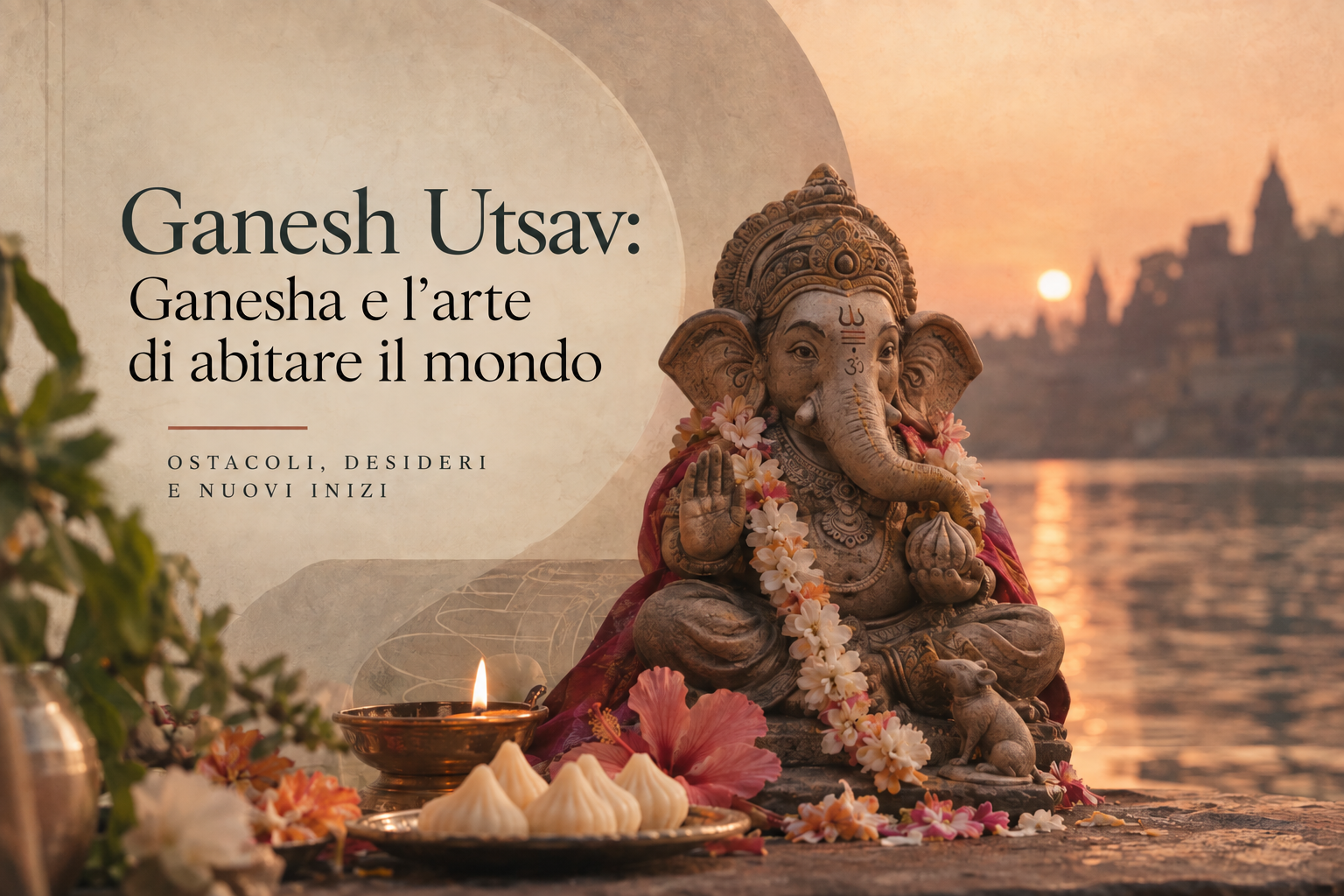
There is an image that, more than many others, has crossed the borders of India and has become familiar in the West as well: a human body with a rounded belly, four arms, and a large elephant head.
It is Ganesha, one of the most beloved deities in Hinduism.
We know him primarily as “the remover of obstacles.” And it is true. One of his names is Vighnahartā, the remover of impediments. But Ganesha is also Vighneśvara, the Lord of obstacles. Not only the one who removes them, then: in tradition, Ganesha presides over obstacles and can also place them on one’s path.
And here the matter becomes much more interesting, because not all obstacles are necessarily our enemies. Sometimes something prevents us from proceeding because we are going in the wrong direction. Sometimes what we call a "block" forces us to stop, observe, learn, and change our path. And sometimes the obstacle does not need to be eliminated: we must become capable of traversing it.
Ganesha's time
Every year, in the lunar month of Bhādrapada, which in our calendar generally falls between August and September, Ganesh Chaturthi is celebrated, the festival dedicated to Ganesha's birth, this year falling on September 14th and inaugurating the Ganesh Utsav, the festive period dedicated to him. In many parts of India, and particularly spectacularly in Maharashtra, for several days Ganesha enters homes, streets, and public spaces through clay statues or images created specifically for the festival. He is welcomed; flowers, light, prayers, food, and modak, the sweets traditionally associated with him, are offered. People sing, recite mantras, and share meals. It is first and foremost a religious and devotional celebration. For millions of Hindus, Ganesha is not an archetype or a beautiful metaphor for overcoming difficulties: he is a deity, loved and revered.
Then comes the time of visarjan. The temporary murti are accompanied to the water and immersed. The form that for days has been welcomed, adorned, nurtured, and worshipped is returned to the elements. The religious meaning of this gesture is broader than any interpretation we can encapsulate in a few lines. Yet that image can also speak to us: form is temporary. What we have welcomed does not necessarily have to remain forever to have had value. Letting go is also part of the cycle.
Ganesha does not invite us to flee the world
However, there is an aspect of Ganesha that I find even more fascinating: His relationship with concrete life.
Ganesha is the son of Shiva and Parvati. There are different accounts of his birth, and in one of the most well-known, Parvati creates him, and Shiva, after beheading him, restores his life with an elephant's head. But rather than seeking a unique formula in his mythology, we can observe what his figure presents to our eyes: Ganesha is an incredibly "earthly" deity.
He has a large belly. He loves sweets. He is associated with prosperity, knowledge, study, and the arts. He is invoked before a journey, a marriage, a job, a study, a new enterprise, at every new beginning.
He does not live only in the space of meditation or prayer; he enters into things. Into the home. Into work. Into money. Into food. Into projects. Into responsibilities. Into desires.
The problem is not possessing something; it is being possessed by what we possess. The problem is not experiencing pleasure; it is becoming enslaved by it. The problem is not desiring; it is losing ourselves within what we desire. Perhaps matter is precisely one of the very first places where we can learn to be present.
An elephant riding a mouse
And then, just look at him. A gigantic elephant head. Enormous ears. Small eyes. A broken tusk. A trunk capable of uprooting a tree and, with the same precision, picking up something tiny.
Over the centuries, every element of Ganesha's iconography has given rise to different interpretations. The elephant's head has been associated with wisdom and discernment, the large ears with the ability to listen. The small eyes with concentration. The trunk with the ability to combine strength and delicacy, adapting action to what is before us. Then there's that broken tusk.
Ganesha is also called Ekadanta, "he who has only one tusk." There are several stories about its origin. In one of the most well-known, Ganesha breaks his own tusk and uses it to continue writing the Mahābhārata under the dictation of the sage Vyāsa, teaching the wisdom of losing something of oneself so that something greater can continue.
But perhaps the detail I love most is at his feet. Because the vehicle of this enormous elephant-headed deity is...a mouse. Small, restless, very fast, capable of sneaking into anywhere. The mouse has also been interpreted in many ways, and one of the most fascinating associates it with desire. That part of the mind that races, wants something. It gets it and immediately seeks something else to nibble on.
Ganesha, however, does not kill the mouse, he rides it.
And it is difficult to find a more effective image.
Desire does not necessarily have to disappear; it can be governed. We can desire without being dragged by what we desire. We can enjoy things without handing them the reins. We can be in the world without being devoured by it.
Celebrating Ganesha
Ganesh Utsav belongs to a living religious tradition, with practices that vary among families, communities, and territories. Therefore, there is no need to improvise a pūjā (offering ceremony) whose gestures and meanings we do not know to dedicate a moment to Ganesha.
We can do something much simpler. Those who own a murti or image of him can prepare a clean space and offer a light, incense, flowers, water, fruit, or something sweet. A gesture of respect and presence.
One of the most well-known mantras dedicated to Ganesha is:
ॐ गं गणपतये नमः
Om Gaṃ Gaṇapataye Namaḥ
Homage to Ganapati.
We can recite it and then remain in silence for a few minutes. And perhaps bring before Ganesha something that, at this moment in our life, we call an obstacle.
First, we can look at it.
Does this obstacle really need to be removed?
Or is it showing me something?
What desire is guiding me?
Am I using the things of the world, or are the things of the world using me?
Because Ganesha's presence at the beginning of paths does not necessarily have to become, for us, the promise of a path without stones, but it can remind us of something more useful: the importance of developing the discernment necessary to understand which stones to move, which to bypass, and which to use to build the path.
We can recognize Ganesha for what he represents within a living religious tradition, even if it is distant from us, and from there, listen to the questions he brings to us Westerners. One, above all: how can we live in the world without losing ourselves in the world?
Eat. Love. Earn. Create. Desire. Build a home. Start a project. Lose something. Begin again. Do not flee from matter. Do not be governed by it: inhabit it. And, within all of this, remain present.
Perhaps Ganesha is not just the one who opens the way.
Perhaps he can remind us how to walk within it.