19 September 2026
Autumn Equinox: Crossing the Point of Balance
Between light and darkness, balance becomes passage and transformation.
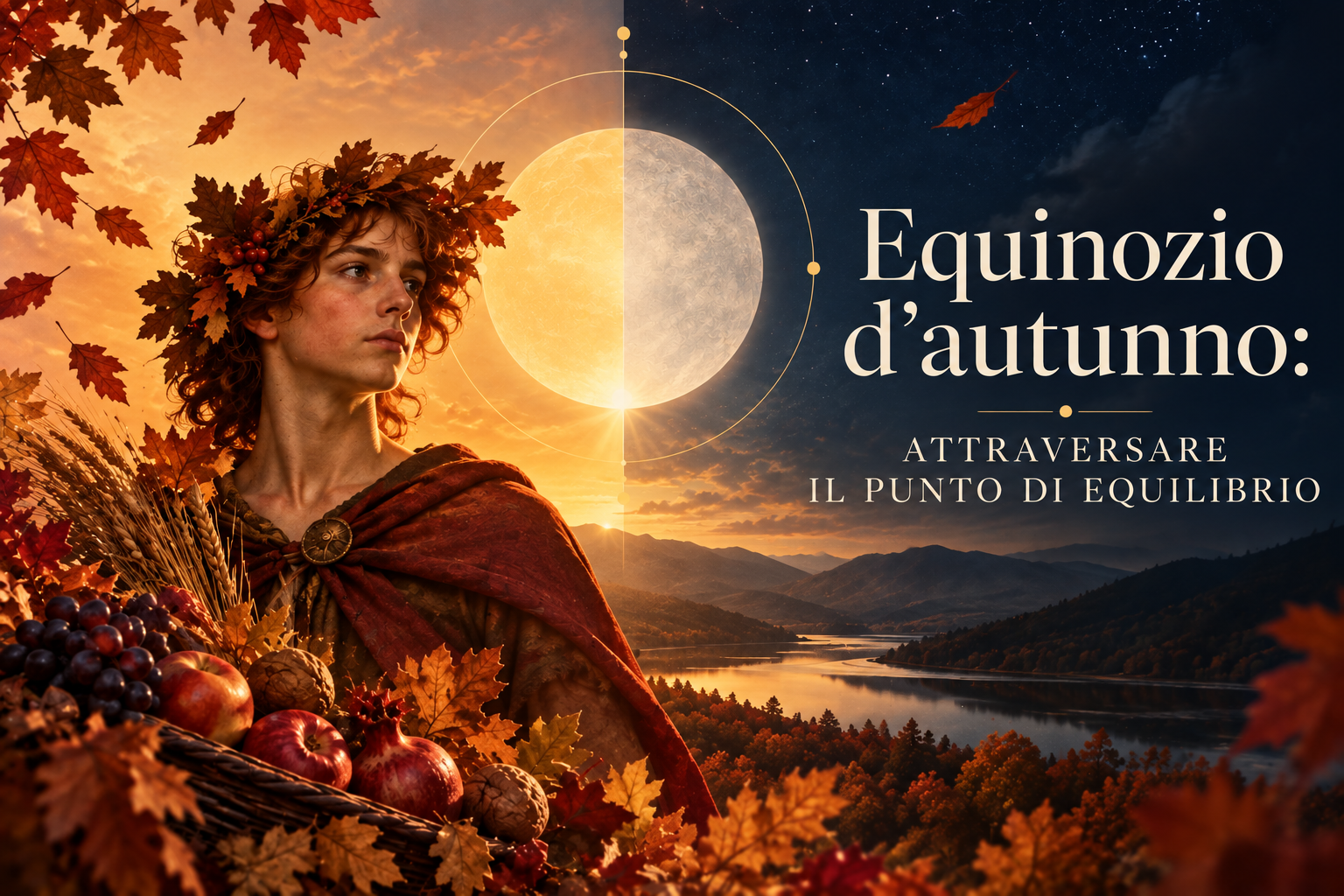
Every year a moment arrives when we say that day and night have the same duration.
It’s not exactly true, and perhaps this is precisely what makes the equinox even more interesting.
On September 23, 2026, at 02:05 AM, autumn will astronomically begin in the Northern Hemisphere. The word equinox comes from the Latin aequinoctium: aequus, equal, and nox, night. But that perfect division between light and dark is mostly an approximation: from an astronomical point of view, day and night do not have exactly the same duration.
They come very close.
And perhaps it is precisely this small imperfection that tells the story of the equinox better than the image of a perfectly still balance. Because the equinox is not a place where nature stands still, suspended between light and darkness.
It is a threshold.
A point of passage.
Then the movement continues.
And we with it.
Balance is not stillness
When we talk about balance, we often imagine something that has finally stopped oscillating: two pans of a scale at the same height. Everything in its place, no force prevailing over another. But in nature, balance rarely resembles this.
A body in balance continues to breathe, a tree in balance continues to move in the wind, an ecosystem continuously changes as it seeks new adjustments.
And we are like that too.
Perhaps being in balance does not mean being able to build a perfect condition and then defend it from any change. Perhaps it means learning to continuously correct movement. Shifting weight. Noticing that something has changed. Letting go of a position when it no longer supports us.
The autumn equinox makes all this visible in the sky.
Light and darkness come very close to equality, and immediately after that, the relationship changes. In our Northern Hemisphere, nights will continue to lengthen until the winter solstice. Balance has already become passage.
The time of harvest
Before the cold and darkness, however, comes the harvest.
For agricultural societies in the Northern Hemisphere, this time of year represented something extremely concrete for millennia: gathering, preserving, transforming.
The harvest was not a metaphor. It was food. It was survival. It was the difference between facing winter with a full granary or with the fear of hunger. For this reason, around late summer and early autumn, many cultures developed festivals, rituals, and customs related to harvesting and gratitude.
Not all coincided with the equinox, and not all had the same meaning. And there is no single, ancient "autumn equinox festival" common to European peoples, but the act of harvesting contains something that we can still perfectly understand:
At some point, we must stop and look at what has grown.
Not what we had imagined would grow.
What is there.
Something will have ripened, something will have remained small, something will not have sprouted at all, something else will have grown where we had sown nothing.
Harvesting also means this: looking at the result without rewriting the season.
Entering the dark part of the year
From this moment, something happens that our body knows long before our mind does: Days shorten, temperatures begin to drop, trees slow down chlorophyll production, and the green of the leaves disappears, and many plants begin to withdraw resources. Animals change behaviors, diet, migrations.
The world does not die. It changes strategy.
And it's an important difference, because we are used to associating spring with opening, summer with expansion, and autumn with loss. But what we see falling is only part of the process. While the leaves detach, the tree continues to live. It simply stops investing energy in what it could not sustain during winter.
Perhaps this is why autumn speaks to us so easily of letting go.
But even this expression risks becoming too simple now.
"Let go of what no longer serves you," we read and hear everywhere.
As if it were enough to recognise something as useless to open our hand and let it fall. But we are not trees, and some things we must let go of have served us very well. A relationship, an identity, a project, a job, a hope.
Sometimes we don't let go of something because it was wrong; we let it go because its time has ended, and this is a very different form of loss.
...And Mabon?
In recent decades, the autumn equinox is often called Mabon, especially in neopagan and Wiccan circles. It is easy to encounter this name presented as that of an ancient Celtic equinox festival.
The story, however, is different. And perhaps even more interesting.
Mabon ap Modron is indeed a figure from Welsh mythology, present in medieval literature. His name and the stories concerning him are therefore ancient. What is modern is the idea of calling the autumn equinox festival Mabon.
This association was introduced by Aidan Kelly, an author and figure in American neopaganism, while he was working on creating a calendar of pagan holidays in the early 1970s. Kelly recounts that he found it curious that some moments of the Wheel of the Year had recognisable names, such as Yule or Beltane, while an equivalent pagan name for the autumn equinox was missing.
So he began to look for one.
His starting point was the Greek myth of Kore, or Persephone, the young goddess whose story is linked to the descent into the underworld and the seasonal cycle. Kelly searched in the mythology of Northern Europe for a story that could offer him a parallel. He did not find what he was looking for in Germanic or Gaelic literature but stumbled upon the Welsh tradition and the story of Mabon ap Modron, the "Son of the Mother," kidnapped from his mother when he was still a child, held prisoner, and finally freed. It was this association that convinced him.
He then chose Mabon as the name for the autumn equinox in the calendar he was building. He did not claim to have rediscovered the lost name of an ancient Celtic festival. He was giving a new name to a modern celebration using a figure from a much older tradition.
The calendar then reached Oberon Zell, then known as Tim Zell, who began to use these names in the neopagan magazine Green Egg. From there, Mabon began to circulate more widely, eventually entering the vocabulary of the modern Wheel of the Year.
There is, however, an important detail. The parallelism imagined by Kelly between Mabon and Persephone is his interpretation, not the literal content of the preserved Welsh tale.
Mabon does not die and cyclically resurrect with the seasons. In the Welsh story, he is taken from his mother when he is just three nights old, is later found imprisoned, and finally freed. This is why it is useful to keep three things separate:
the equinox is ancient as an astronomical phenomenon;
Mabon ap Modron belongs to an ancient Welsh mythological tradition;
calling the autumn equinox celebration Mabon is, however, a modern neopagan tradition.
And there is nothing wrong with this.
Traditions do not cease to have meaning because they are recent. On the contrary, the story of Mabon reminds us of something interesting about how traditions are born: someone gathers images, stories, and symbols from the past, reinterprets them through their own time, and creates something that other people recognise as significant.
Then that gesture is repeated. The name passes from one person to another, enters books, rituals, communities. And at some point, it becomes tradition.
Today, for many people who follow Wiccan or neopagan paths, Mabon is truly an important moment in the Wheel of the Year, linked to harvest, gratitude, balance, and preparation for the darker part of the year. And we don't need to trace it back thousands of years to recognise its value.
Light vs. darkness
Then there is an image from which it is difficult to distance oneself: "Light and darkness."
We have built many metaphors around this pair. Light as knowledge, life, good, awareness. Darkness as ignorance, fear, death, evil.
But one only needs to observe a natural cycle to realise that this opposition is valid but insufficient.
The seed germinates in the dark, roots grow in the dark, we sleep in the dark. Many animals live and orient themselves in the dark. The body uses darkness to regulate some of its rhythms. Night is not a mistake of the day, and autumn is not a spring that failed.
Perhaps one of the most interesting things about the equinox is precisely this: Both belong to the cycle.
After the autumn equinox, in our hemisphere, darkness will progressively occupy more space. We can fight it. Or we can ask ourselves what happens when we stop considering every phase of contraction as something to correct.
Not everything must continuously grow. Not everything must continuously produce. Not everything must be continuously visible. There are moments to expand, and moments to conserve energy.
What to bring with us into winter
Perhaps then the most interesting gesture of the equinox is not just asking:
What do I want to let go of?
We can ask a different question.
What do I want to bring with me?
If autumn is also the time of harvest, before emptying, we must recognise what is worth preserving.
Which experience from this year do I want to keep?
What have I learned?
What has grown?
Which relationship do I want to nourish?
Which part of me needs to be protected during the colder months?
And only then can we look at what takes up space without nourishing us anymore.
What has completed its cycle?
What do I continue to hold onto just because it was once important?
Where am I spending energy to maintain something that can no longer grow?
What can I stop feeding?
Not to make room for something new immediately.
This, too, is a very contemporary, new-age automatism: closing one thing and immediately opening another. Filling the void. Producing a new version of ourselves.
Nature, however, also knows empty ground and does not create versions of itself; it lives them without masks.
Celebrating the equinox
It is not necessary to belong to a religious tradition to recognise an astronomical passage that concretely changes the world around us.
We can simply light a candle when evening arrives.
Bring something from the season to the table: apples, grapes, bread, nuts, pumpkin, herbs, what the land offers at this moment. Not as scenery, but as a reminder.
On September 23, at 02:05 AM, we will see nothing spectacular. No flash in the sky, no line will separate light from darkness. The Earth, the stars, nature, will simply continue their journey, and precisely in this movement, we will cross one of the points we have chosen to orient ourselves, because perhaps the equinox does not ask us to choose between light and darkness.
It reminds us that with the right awareness, we are capable of traversing both.